
DRAFT 101 · UPDATED OCTOBER 21, 2026
The offense sends two tight ends into the huddle. Should the defense prepare for a physical running play or a spread passing formation? That uncertainty explains the appeal of big nickel and the draft value of defenders who can handle more than one kind of assignment.
What is 12 personnel?
The first digit counts running backs; the second counts tight ends. Twelve personnel therefore means one running back and two tight ends, leaving two wide receivers alongside the quarterback and five offensive linemen. It says who is playing, not where everyone must line up.
An offense can attach both tight ends to the formation, place one in the slot or move one into the backfield. If both can block and threaten coverage, the defense has to respect different possibilities without necessarily receiving a substitution opportunity.
What makes nickel “big”?
Nickel means five defensive backs. A conventional version often uses three corners and two safeties. Big nickel commonly uses two corners and three safeties. The additional safety is intended to offer a useful balance of coverage ability and run support.
The name does not guarantee a particular front or coverage. A defense can arrange the same five defensive backs in different ways. Nor is a third safety automatically preferable to a third corner: the right answer depends on the opponent and the individual players.
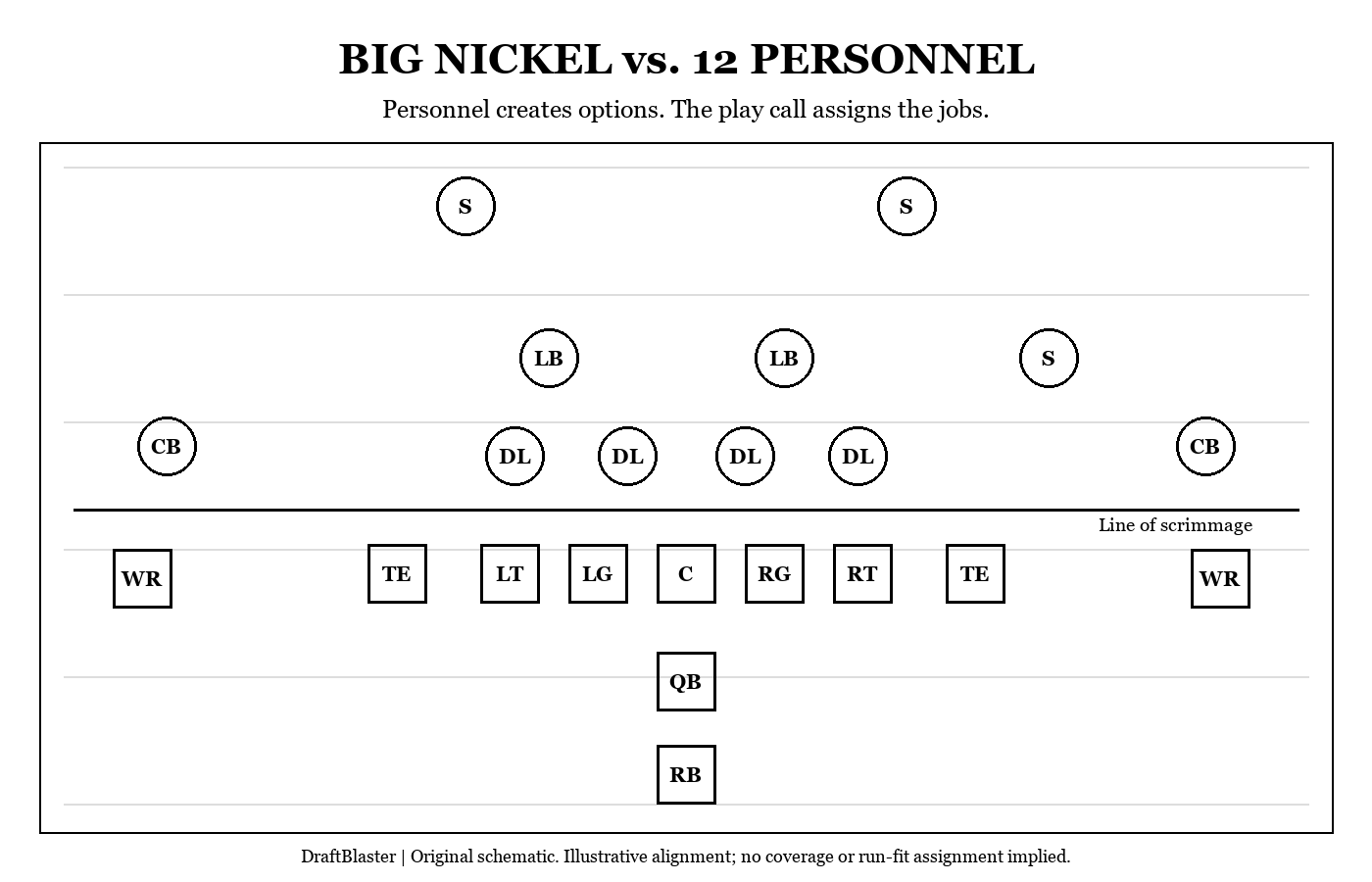
The matchup dilemma
Answer two tight ends with heavier personnel, and the offense may spread the formation and target a slower defender in space. Answer with a lighter package, and it may run directly at that package. A capable third safety can help reduce the cost of either choice.
There is no universal solution. A safety who cannot stay with a receiving tight end still creates a coverage problem. One who cannot take on or avoid blocks can become the target of the running game. The role requires evidence of both skills.
A simple personnel comparison
Conventional nickel: 3 cornerbacks + 2 safeties = 5 defensive backs.
Big nickel: 2 cornerbacks + 3 safeties = 5 defensive backs.
Possible offensive opponent: 1 running back + 2 tight ends + 2 wide receivers = 12 personnel.
These counts describe personnel only. They do not determine who rushes, who covers the slot or how many defenders are responsible for deep zones. Those assignments belong to the play call.
What a hybrid safety must demonstrate
Look for sound angles, dependable tackling, route recognition, communication and the ability to change direction without losing leverage. Distinguish covering a tight end from covering a wide receiver; the releases, route spacing and physical demands can differ.
A defender who played several positions in college may offer flexibility. He may also need a more defined role. Identify his best NFL assignment first, then ask whether his secondary skills let the coordinator keep him on the field against different offensive looks.
How this changes a mock draft
A team may need a safety even if two familiar names already occupy the depth chart. The third safety can have a substantial tactical role. Conversely, collecting versatile defenders does little good if none can perform the central assignment reliably.
DraftBlaster’s archived article called this player a “super safety.” The enduring idea is the value of useful versatility. The updated evaluation is more specific: what jobs can he perform well, against whom, and at what cost? See the defensive schemes guide and offensive personnel and formations for the surrounding concepts.